

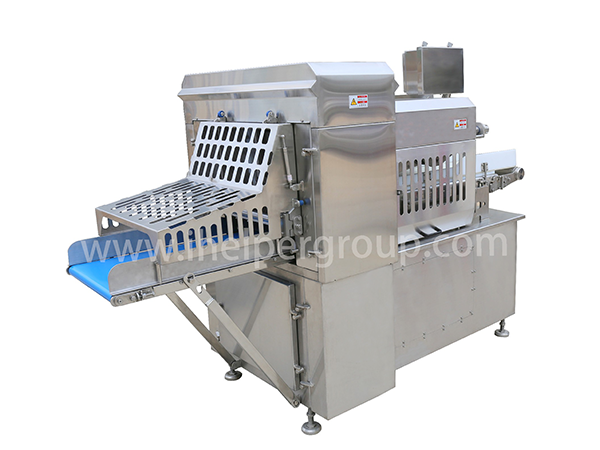
The working principle of an industrial meat cutting machine varies according to its type. These machines are mainly classified into meat bowl cutters, slicers, and strip-and-dice cutters, with all of them relying on mechanical power to achieve efficient cutting.
Meat bowl cutters are driven by variable-frequency motors to rotate multiple sets of cutting blades at high speed, generating eddy shear force inside the mixing bowl. The blades maintain a gap of 0.5–2 mm from the bowl wall. Coordinated with the rotation of the bowl, the meat material undergoes three-dimensional cyclic cutting. The combined control of blade speed and bowl speed can effectively regulate the temperature rise during processing, ensuring the emulsification effect of the material while preventing protein denaturation.
Meat slicers are mainly divided into two types: rotary blade type and reciprocating type. The rotary blade type uses a high-speed rotating circular blade (usually with a rotational speed of 1000–5000 rpm). Fresh meat is sliced under the action of gravity or conveyor belt feeding. The reciprocating type drives a long strip blade to perform reciprocating linear motion through a crankshaft connecting rod mechanism, cutting off a slice of meat with each forward stroke. This method delivers better cutting results for tough meat.
Meat strip-and-dice cutters usually adopt a conveyor belt feeding system and a hob-type cutter set. After the meat material is fixed on the conveyor belt, it is continuously cut into strips or cubes by the scissor-like cutter set, realizing efficient assembly-line operation.