

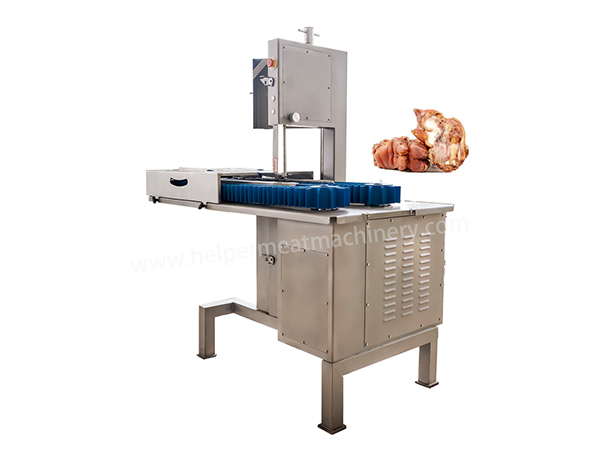
Maintenance of the bone saw machine shall be performed in daily, weekly and monthly schedules. The whole work focuses on food hygiene and safety as well as low component wear, which can greatly extend the service life of the equipment and prevent sudden failures such as saw blade breakage and motor burnout.
1. Daily Maintenance (End of Shift)
Cut off power completely and unplug the power cord before any operation to eliminate risks of live operation. Empty bone scraps from the scrap tray. Dismantle the saw blade and scraper. Thoroughly clean blood stains and grease on surfaces with warm water and neutral food-grade detergent. Wipe the stainless steel body and sliding push plate simultaneously. Do not use high-pressure water jet to flush the motor and electric control box directly, otherwise water ingress may burn out the motor.
Inspect the saw blade for cracks and burrs, confirm the saw blade tension is within normal range, and test whether the magnetic safety switch of the machine door is sensitive. The equipment shall power off and stop immediately once the door is opened.
Reassemble all cleaned parts only after they are fully wiped and air-dried to avoid residual moisture inside bearings leading to rust.
2. Weekly In-depth Maintenance
Apply a small amount of food-grade lubricant to drive wheels, upper and lower pulley shafts and push plate guide rails. Ordinary industrial oil is prohibited to prevent food contamination. Clean meat residues trapped in pulley gaps; residual debris will abrade the saw blade and cause abnormal noise.
Inspect the belt drive system and confirm proper belt tension. It is qualified when the deflection under pressing is ≤3 mm. Replace heavily worn belts in a timely manner.
Test the braking function of the equipment. Open the machine door directly after startup and verify that the saw blade can stop rapidly within 2 seconds to guarantee operation safety.
3. Monthly Comprehensive Inspection
Disassemble the outer casing of the bone saw machine, clear accumulated bone dust and dirt inside. Check motor wires for aging and insulation damage to avoid short circuit caused by contaminants.
Fully calibrate the perpendicularity of the saw blade. Skewed saw blades directly cause frequent blade breakage and uneven cutting sections. Perform no-load test after calibration to confirm no radial runout of the saw blade.
Check bearings for shaking and abnormal noise. Replace bearings promptly when the clearance exceeds 0.05 mm. Fully tighten all fixing screws on the machine body to eliminate loosening caused by long-term vibration.