

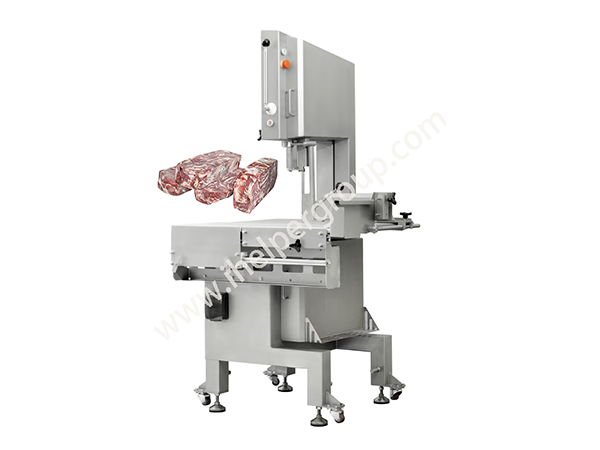
Industrial meat grinder are powerful tools for meat processing enterprises, capable of finely processing raw meat into granular minced meat of various specifications during production. They are widely used in the manufacture of meat products such as sausages, luncheon meat, and meatballs, and also serve as essential equipment in hotels and canteens.
Industrial meat grinder rely on the cooperation between the rotating cutter blades and the hole edges on the orifice plate to generate a shearing effect, which cuts the raw meat into pieces. Driven by the extrusion force of the screw, the chopped raw meat is continuously discharged out of the machine. By flexibly configuring different cutters and orifice plates, meat grinders can easily adapt to various material properties and processing requirements, and output particle sizes that meet the technological requirements of subsequent processes. In addition, industrial meat grinders are classified into various types including bench-top grinders, single grinders, and combined grinding & cutting machines to satisfy different production needs.
1. Pre-installation Preparation
Before installing an industrial meat grinder, first inspect all components to ensure there is no damage or missing parts. It is crucial to select a flat and stable workbench for assembly to guarantee the smooth progress of installation.
2. Specific Installation Steps
According to the operation manual, install all components one by one in the correct sequence, and ensure all connections are fastened without loosening. After installation, it is recommended to conduct a trial run to confirm that the industrial meat grinder can operate normally. During the installation process, be sure to follow the instructions in the operation manual to ensure the safe and smooth completion of the grinder’s installation.