

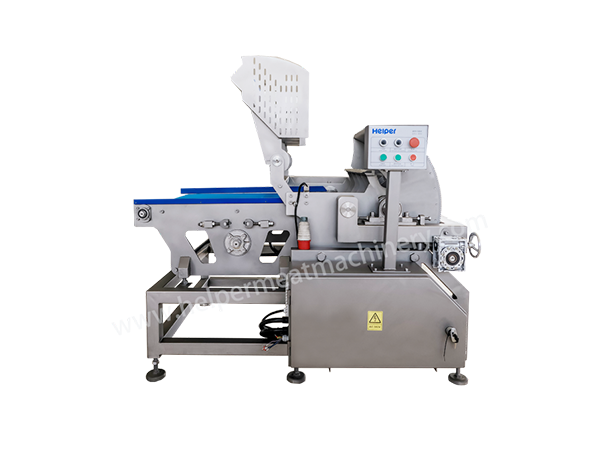
The core objectives of routine maintenance for sausage production lines are food hygiene & safety and stable equipment precision. Maintenance tasks are implemented on daily, weekly, monthly and annual schedules. This prevents microbial growth from residual materials, greatly reduces unplanned downtime and extends equipment service life.
1. Mandatory Maintenance after Daily Production
Complete material residue removal: Immediately empty all meat batter residues from hoppers, chopping chambers, stuffing nozzles and conveyor mesh belts. Flush all 304 stainless steel product-contact components with food-grade detergent and hot water above 60℃. Never leave meat residues overnight, which may cake, spoil and corrode equipment.
Pneumatic and electrical safety inspection: Check power wiring and air pipe fittings for looseness or leakage. Remove surface dust and dust from heat dissipation holes of electrical control cabinets. Verify that safety interlocks and emergency stop buttons function normally to eliminate potential hazards before next startup.
Preliminary inspection of cutters and passages: Check chopping blades and stuffing outlets for adhered materials. Rinse with clean water and dry. Spray food-grade disinfectant on product-contact metal surfaces. Cover with dust protection after natural air-drying.
2. Weekly Special Maintenance
Lubrication of transmission components: Apply food-grade dedicated lubricating oil to moving parts including gears, bearings and transmission hinges. Ordinary industrial lubricants must not be used to avoid leakage and contamination of meat products; meanwhile dry friction and component wear can be reduced.
Inspection of sealing elements: Focus on checking whether pistons of stuffers, chamber sealing rings and pipeline gaskets are aged, deformed or leaking. Replace seals immediately once elasticity declines to prevent material leakage into equipment and bacterial proliferation.
Pre-inspection of wearing parts: Check clipping blades of clipping machines and nozzles of smoking ovens for wear and blockage. Clean oil sludge and carbon deposits inside spray holes to ensure smooth operation.
3. Monthly In-depth Maintenance
Calibration of core components: Calibrate the clearance between chopping blades and chopping plates to within 0.5–1 mm for uniform meat batter emulsification. Recalibrate the volumetric filling accuracy of the stuffer and stabilize filling tolerance within ±1%.
Descaling of thermal systems: Remove scale and oil contamination from heating plates and heat exchange tubes of smoking ovens and cooking lines. Scale buildup reduces thermal efficiency; descaling ensures accurate temperature and humidity control.
Moisture-proof treatment for electrical systems: Open electrical cabinets and clear internal dust. Inspect wiring terminals for oxidation and cold solder joints and tighten terminals. Power on control cabinets in humid environments to drive out moisture and prevent short circuits of circuit boards caused by dampness.
4. Annual Overhaul Maintenance
Full replacement of core fluids: Completely replace vacuum pump oil for choppers and vacuum mixers. Clean impurities inside pump chambers to maintain stable vacuum level and avoid oxidation and discoloration of meat batter.
Full-line precision verification: Recalibrate all temperature, pressure and flow sensors using standard samples. Back up PLC control programs to prevent process deviation caused by parameter drift.
Batch replacement of wearing parts: Replace aged sealing rings, drive belts, blades and other consumable parts. Conduct flaw detection on worn transmission components to eliminate hidden faults in advance.