

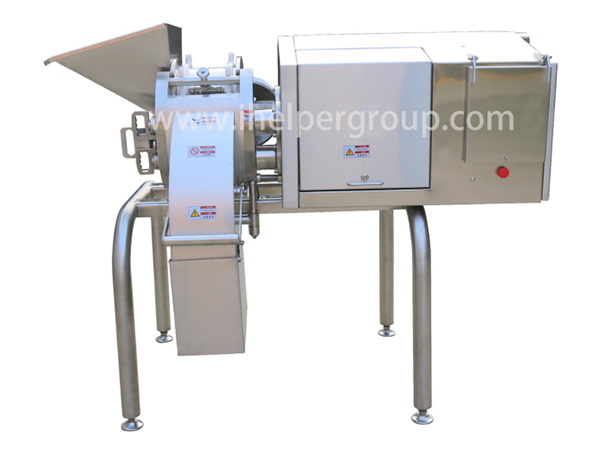
Compared with manual cutting and small commercial equipment, industrial meat cutting machine deliver core advantages in production efficiency, standardized processing, food safety and cost reduction. The details are as follows:
Core Advantages
1. High productivity for large-scale production
The output of industrial meat cutting machine generally reaches 500 to 1,000 kilograms per hour. Some large cutting lines can process 3 to 5 live pigs every hour, with efficiency 3 to 5 times higher than manual work. The equipment is capable of continuous high-load operation for 24 hours, fully meeting the mass production demands of large meat processing plants and central kitchens. Some fully automatic models feature automatic feeding and can be combined with meat grinders, choppers and other equipment to form a continuous production line, further boosting overall plant efficiency.
2. Precise and uniform cutting for standardized products
Equipped with mechanical positioning and intelligent control systems, the machines achieve high cutting accuracy. The weight error is controlled within ±2 grams, and the slicing thickness can be adjusted to an accuracy of 0.1 mm. Custom cuts including cubes, shreds and slices are available within the thickness range of 5 mm to 120 mm. Processed meat pieces feature uniform size and consistent fat-meat ratio, which improves product appearance and market competitiveness. It also cuts material loss caused by uneven cutting, reducing the wastage rate by 3% to 5% compared with manual operation.
3. Optimized hygienic design complying with food safety standards
All meat-contact components such as the machine body, blades and knife grids are mainly made of 304 food-grade stainless steel. The seamless and dead-angle-free surface prevents residue of meat scraps and blood, inhibiting bacterial growth.
Most blade assemblies allow tool-free quick disassembly, and certain models are fitted with an automatic high-pressure cleaning system for easy daily cleaning and disinfection.
The equipment greatly reduces direct human contact with meat, lowering the risk of cross-contamination at the source and strengthening food safety control.
4. Wide adaptability for diversified processing
Industrial meat cutters suit various working scenarios. They can directly slice frozen meat at temperatures below -18°C, avoiding protein loss caused by traditional thawing procedures. The machines also handle chilled fresh meat, partially thawed meat, bone-in poultry and cooked meat, and can produce diced meat, shredded meat, slices and strips in various shapes.
Adopting a modular design, the cutting modules can be flexibly switched for processing pork, beef, mutton and other varieties. Custom solutions are available for facilities of all sizes, ranging from small workshops to large fully automatic production lines.
5. Lower overall costs and higher economic benefits
Reduced labor reliance: The core cutting process is automated. A production line only requires 3 to 5 operators, cutting labor input by over 60% compared with the traditional manual mode, and easing the problems of labor shortage and high labor costs.
Lower energy consumption: For direct processing of frozen meat, energy consumption is reduced by approximately 65% versus the conventional thawing and cutting process. New variable-frequency models further cut energy use by 20% to 30% against traditional units, bringing substantial long-term operational cost savings.
Excellent durability: The core blades are made of special alloy steel with a service life of up to 3,000 working hours. The stainless steel body is wear and corrosion resistant, with an overall service life of more than 10 years, delivering superior cost performance.