

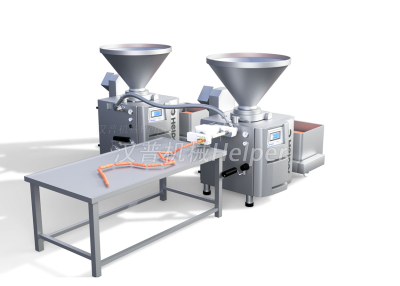
The process flow of a sausage production line is a systematic and standardized procedure that combines raw material handling, processing, packaging, and sterilization to ensure product safety, hygiene, and stable flavor.The detailed process flow of a typical sausage production line is as follows:
1. Raw Material Preparation & Pre-treatment
Raw Material InspectionCheck the freshness, fat ratio, and hygiene indicators of meat (pork, beef, chicken, etc.) to ensure compliance with food standards.Excipients (starch, spices, preservatives, etc.) must be verified as qualified.
Thawing (if required)Frozen raw materials are thawed slowly in a thawing room to avoid meat softening or bacterial growth caused by rapid temperature rise.
Washing & TrimmingRemove impurities, fascia, bones, etc., from the meat surface, and cut into pieces suitable for processing.
2. Grinding & Mixing
GrindingUse a meat grinder to mince the meat into fillings of different particle sizes (coarse or fine), adjusted according to product requirements.
Chopping & EmulsifyingStir the meat filling at high speed in a bowl cutter, while adding salt, phosphate, and other additives to promote protein extraction, forming a viscous meat emulsion and improving elasticity.
MixingAdd excipients such as starch, spices, seasonings, and preservatives according to the formula, and mix thoroughly to ensure consistent flavor.
3. Curing (optional)
Dry CuringAdd curing agents such as salt and nitrite directly into the meat filling, and let stand to allow penetration.
Wet CuringSoak the meat filling in a container with curing liquid; penetration is accelerated by vacuum or pressure.
Injection CuringUse a multi-needle injector to evenly inject curing liquid into large pieces of meat to improve curing efficiency.
4. Filling & Forming
Casing PreparationSelect natural casings (sheep, pork) or artificial casings (collagen, cellulose), soak to soften, and mount on the filling machine.
FillingUse a vacuum filling machine to fill the meat emulsion evenly into casings. Control filling pressure to avoid rupture and remove air to prevent oxidation.
Linking / TwistingSegment and link the sausages mechanically or manually into fixed lengths (e.g., 10–15 cm per piece).
5. Drying & Smoking (for some products)
DryingRemove surface moisture in a drying chamber via hot air circulation to form a protective layer and extend shelf life.
SmokingSmoke sausages with smoke from wood chips to provide unique flavor and color, while also exerting a bactericidal effect.
6. Cooking / Ripening
CookingPlace sausages in a cooking stove and heat with steam or hot water until the core temperature reaches above 72°C to kill pathogens and coagulate proteins, forming a stable structure.
CoolingCool rapidly with cold water or cold air after cooking to prevent meat hardening from overcooking and inhibit bacterial growth.
7. Packaging & Sterilization
Vacuum PackagingUse an automatic packaging machine to vacuum-seal sausages, isolating oxygen and extending shelf life.
High-Temperature SterilizationSubject packaged sausages to high-temperature and high-pressure treatment (e.g., 121°C for 15–30 minutes) to completely kill microorganisms and achieve commercial sterility.
8. Inspection & Storage
Quality InspectionCheck packaging integrity, appearance, weight, and microbial indicators; remove defective products.
Labeling & BoxingPrint production date, shelf life, and other information, then pack into cartons according to specifications.
Storage & TransportationStore at 0–4°C or at room temperature, away from direct sunlight and high temperatures.
Critical Control Points
Temperature Control: Strictly monitor temperature during grinding, chopping, cooking, etc., to prevent bacterial growth or meat deterioration.Hygiene Management: Regular cleaning and disinfection of the production line; operators must wear protective clothing to avoid cross-contamination.Additive Usage: Strictly comply with national standards, control the dosage of nitrite and other additives to ensure food safety.
Through the above process, the sausage production line achieves efficient and standardized production, meeting market requirements for quality and safety.Different enterprises may adjust process parameters according to product types, but the core steps are basically consistent.