

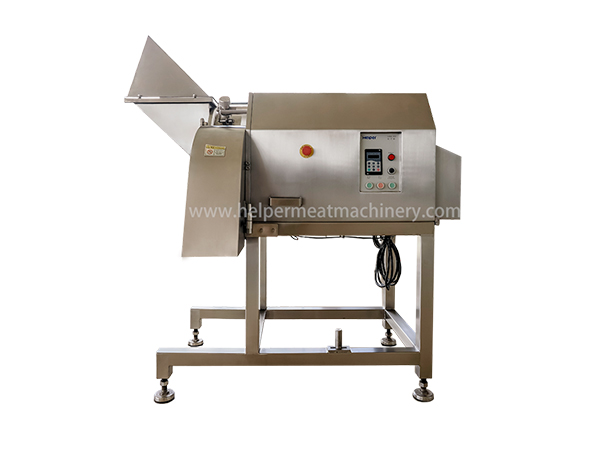
The core considerations for purchasing an industrial meat cutter include matching material status (fresh/frozen meat) and capacity requirements, confirming food‑grade 304 stainless‑steel body, adequate‑power motor, easy‑to‑disassemble‑and‑clean structure and compliant safety design.
1.Material Adaptability
Clarify whether the main processing objects are fresh meat, semi‑frozen meat (-4℃ ~ -18℃) or fully frozen meat. For frozen‑meat processing, models equipped with special high‑torque motors and hard‑alloy cutter assemblies are mandatory. Ordinary units will suffer blade damage and machine jamming if forced to cut frozen meat.
2.Matching of Capacity and Power
Select models according to peak output (kg/h) and reserve a 20%‑30% margin. The motor power shall match cutting resistance (normally ≥2.2 kW for frozen meat cutting). Beware of falsely‑labeled production capacity.
3.Material and Sanitary Design
Food‑contact components must adopt **304 or 316 food‑grade stainless steel**. Sheet‑metal parts of the machine body shall have smooth surfaces without dead corners. Prioritize designs supporting quick disassembly or direct high‑pressure water‑gun washing (waterproof rating IPX5 or above).
4.Cutting Precision and Cutter Assembly
Check blade material (high‑carbon stainless steel / special alloy) and heat‑treatment process. Verify whether thickness adjustment is accurate and stable to guarantee uniform finished‑product size.
5.Safety Protection Configuration
Essential safety features include emergency‑stop button, hand‑intrusion prevention device at feeding inlet, guard‑interlock shutdown (machine stops once the cover is opened), and overload‑protection function.
The principles for dicing/slicing fresh meat differ from those for mincing frozen meat. For high‑demand applications, dedicated machines for separate processes are recommended to avoid compromised performance of all‑in‑one units.
Do not rely merely on nominal parameters for industrial meat cutting machine. It is advisable to bring actual raw materials for on‑site tests to evaluate cutting performance, noise level and continuous‑operation stability. Give priority to manufacturers with in‑house production of core components, long‑term operation history and complete after‑sales spare‑parts commitments, so as to avoid assembly‑type products from small workshops with unavailable after‑sales support.