

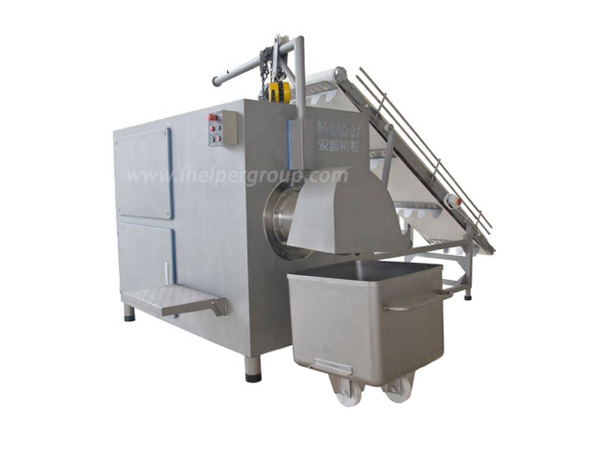
In the meat processing industry, efficient and standardized industrial meat processing equipment is critical for boosting production capacity and product quality, whether for central kitchens, food factories or large canteens. Faced with fresh meat strip cutting machines featuring diverse functions and numerous parameters on the market, procurement personnel often encounter confusion: how to select the unit that suits production line demands and balances efficiency and cost from various brands and models? What is the actual performance behind the “high capacity” claimed by different machine models? This article sorts out core purchasing guidelines to eliminate confusion and support informed decision-making.
The core principles for purchasing industrial meat processing equipment are: matching production capacity with processing technology, complying strictly with hygiene standards for food-grade materials, verifying performance under low-temperature and heavy-load conditions, and confirming after-sales response capability. Avoid making decisions based merely on price or nominal parameters.
1.Matching Production Capacity and Processing Technology
Clarify the daily processing volume (tons), raw material status (frozen meat at -18°C or fresh meat at 0–4°C), and finished product specifications (particle size / thickness / weight). Prevent equipment overload due to insufficient capacity or energy waste caused by overcapacity. Confirm whether the equipment supports quick mold change to accommodate multi-variety production.
2.Material Selection and Hygiene Compliance
All material-contact components must be manufactured from 304 / 316L food-grade stainless steel with smooth surfaces and no dead corners to meet relevant requirements. Transmission parts shall adopt sealed structures to prevent oil leakage. The overall structure shall allow quick disassembly and cleaning (quick-release design) to avoid meat residue and bacterial growth.
3.Key Performance Indicators
For frozen meat processing equipment, focus on motor torque and blade hardness (special alloy steel) to ensure smooth operation without jamming under low temperatures and prevent meat thermal denaturation caused by temperature rise. Inspect automation level, safety protection configuration and noise level. Require manufacturers to provide measured production capacity under specified working conditions instead of theoretical maximum values.
4.After-sales Service and Life Cycle Cost
Verify the spare parts supply cycle (preferably ≤72 hours), fault response time, technical training support and warranty terms. Evaluate manufacturers’ production capacity and industry project cases. Prioritize suppliers offering full-cycle services including pre-sales technical calculation, machine trial and acceptance, and on-site commissioning.