

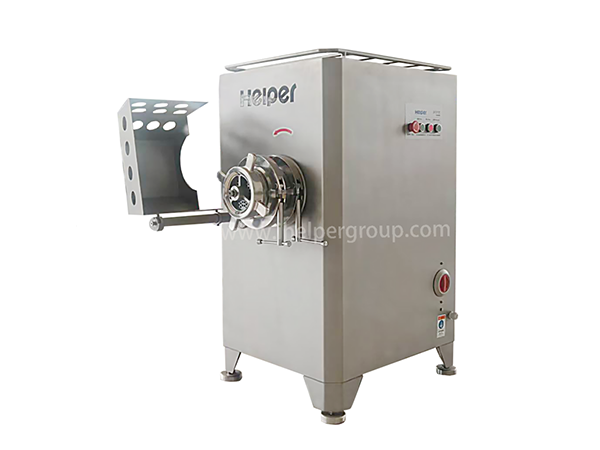
Common faults of industrial meat cutting machine can be divided into six categories, covering core application scenarios such as power supply, cutting performance and operating status, as detailed below:
1. Failure to start / sudden shutdown
Main causes: disconnected power supply / unstable voltage, unreleased emergency stop button, incompletely closed safety guard door, tripped motor overload protection, broken control circuit or blown fuse.
Typical symptoms: No response after pressing the start button; sudden power-off shutdown during operation.
2. Uneven cutting size / poor cutting quality
Main causes: worn, loose or improperly installed blades, mismatch between feeding speed and cutter rotating speed, insufficient pressure of meat pressing device, excessive tendons or large size variation of raw materials.
Typical symptoms: Large thickness deviation of cut meat blocks/strips, excessive fine meat scraps, and incomplete cutting of partial materials.
3. Material blockage / machine jamming
Main causes: oversized and hard raw materials, residual meat scraps in the feeding channel, cutter assembly jammed by bone fragments or foreign objects, insufficient stroke of material-pushing cylinder.
Typical symptoms: Meat blocks cannot be fed into the cutting zone; the cutter assembly is fully locked and unable to rotate; a large amount of material accumulates at the discharge port.
4. Abnormal operating noise / severe vibration
Main causes: worn and under-lubricated bearings or gears, loose and slipping transmission belt, friction between blades and guard plates, loose fasteners, unstable equipment placement.
Typical symptoms: Friction or impact noise during machine operation, obvious shaking and displacement of the machine body.
5. Abnormal discharge / poor forming
Main causes: offset or deformed guide plate, tearing caused by dull cutting blades, excessively high or low material temperature, misaligned receiving device.
Typical symptoms: Meat leakage at discharge port, agglomerated meat strips, irregular shape of finished products.
6. Slippage or inactivity of feeding mechanism
Main causes: loose conveyor belt or chain, slippage caused by meat scraps and grease adhered to the surface, damaged and locked driving gears or chains.
Typical symptoms: Meat blocks cannot be effectively conveyed into the cutting area, and the feeding device idles.