

When investing in an industrial sausage production line, blind equipment procurement often leads to mismatched process rhythm, unstable product quality and idle investment. The selection logic should follow product positioning → production capacity → process route → equipment matching → factory conditions → after-sales & traceability system. Combined with the three-stage drying process for cured sausages, this guide systematically elaborates the core selection criteria.
1. Clarify Product Types & Process Routes First
Different sausage varieties require completely different line configurations, which is the primary basis for equipment selection.
(1) Chinese-style Dried Cured Sausages (Cantonese Sausage, Sichuan Preserved Sausage)
Typical process: Raw material pretreatment → grinding → vacuum mixing → vacuum stuffing → hanging → three-stage gradient drying → cooling → packaging
Key equipment focus:
Hydraulic vacuum stuffer (adaptable to high-viscosity dry filling); automatic tying/linking machine
Programmable hot-air drying chamber supporting segmented temperature, humidity and wind speed control; data logging for water activity monitoring
No mandatory bowl cutter; vacuum mixer is preferred to avoid excessive air bubbles
(2) Emulsified Cooked Sausages (Hot Dog, Taiwanese Grilled Sausage, Crispy Sausage)
Typical process: Raw material trimming → grinding → bowl cutting & emulsification → vacuum mixing → quantitative stuffing & twisting → cooking/smoking → cooling → packaging
Key equipment focus: High-speed bowl cutter; volumetric vacuum filler with automatic twisting function; smokehouse integrating cooking, smoking and baking
(3) Fermented Sausages
Extra requirements: Constant-temperature curing room; low-temperature low-humidity ripening & drying system; pH and water activity online monitoring function
Critical reminder: If multiple categories are produced simultaneously, select modular production lines to avoid equipment dedicated to single products.
2. Define Reasonable Production Capacity & Equipment Balance
Determine hourly output or daily output, and reserve 15%–20% capacity margin for peak orders.
Capacity classification reference:
Small-scale plant: 100–500 kg/h → semi-automatic modular configuration
Medium industrial plant: 500–1,500 kg/h → semi-full automatic linkage
Large-scale continuous production: ≥1,500 kg/h → fully automatic integrated production line
The most common mistake: Single equipment with high capacity while upstream and downstream equipment cannot match, causing production bottlenecks.
Matching principle:
Grinding & mixing capacity ≥ stuffing capacity; stuffing batch output shall match the trolley load of drying/smoking ovens; avoid frequent waiting between processes.
3. Core Equipment Selection Key Points
(1) Raw Material Preprocessing Section
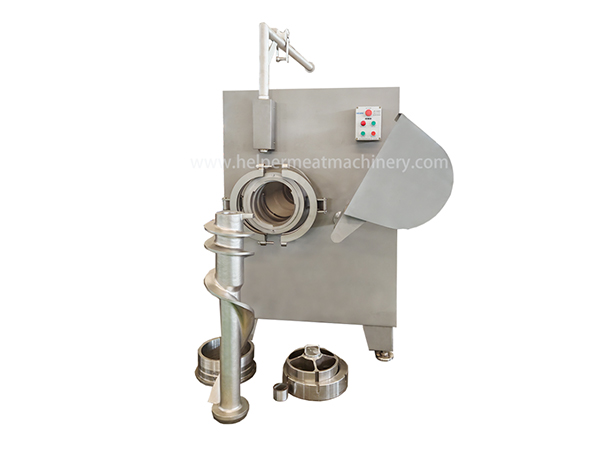
Grinder: Choose low-temperature grinding model to prevent meat temperature rise; replaceable hole plates for different particle textures.
Vacuum mixer: Essential for cured sausages; vacuum environment reduces air bubbles, improves color formation and texture.
Bowl cutter: Only required for emulsified sausages; strictly control meat temperature during emulsification.
(2) Stuffing & Forming Section
Volumetric vacuum filler (twisting type): For small-diameter emulsified sausages, high metering accuracy
Hydraulic vacuum filler: Recommended for dried sausages, stable pressure for high-viscosity filling, less casing breakage
Supporting: Automatic linking machine, casing pricking device (to prevent bulging and cracking during drying)
(3) Drying / Smokehouse (Core Equipment for Dried Sausages)
This equipment directly determines drying quality and solves defects such as crusting, uneven color and sourness. Mandatory technical requirements:
Independent precise control of temperature, relative humidity and air velocity
Support multi-stage automatic program (realize three-stage drying curve: preheating shaping → uniform dehydration → ripening & stabilization)
Temperature deviation inside chamber ≤ ±1 ℃, uniform airflow distribution
Continuous data recording for temperature, humidity and running time (meet food traceability & HACCP requirements)
Easy internal cleaning, no dead corners, 304 stainless steel inner tank
Heating mode: Electric / steam heating; steam has better temperature stability for large-scale factories.
(4) Post-treatment & Packaging
Cooling tunnel (reduce product core temperature below 25 ℃ before packaging); vacuum packaging machine; metal detector for foreign matter inspection.
4. Site, Utilities & Hygiene Compliance
Workshop layout: Follow the principle of raw area and cooked area separation, one-way logistics to avoid cross-contamination; reserve trolley turnover space for drying rooms.
Utility conditions: Confirm power capacity, steam supply, compressed air, drainage before equipment customization.
Material standard: All product contact parts adopt food-grade 304 stainless steel; easy disassembly and washing, support CIP cleaning as an option.
Compliance: Equipment structure meets food production licensing & food safety audit requirements.
5. Automation Level & Investment Budget Matching
Semi-automatic line: Low initial investment, flexible for multi-product small-batch production; suitable for new factories and diversified product lines.
Fully automatic linkage line: Less labor, stable consistency; suitable for single-variety mass production; higher maintenance technical requirements.
Suggestion for startup factories: Prioritize core process automation (vacuum stuffing + intelligent drying chamber), retain manual turnover for front-end and back-end, and expand automatic feeding/hanging equipment in later phases.
6. Supplier Assessment & Technical Service (Easily Overlooked)
Verify whether the supplier has mature case experience of Chinese-style dried sausage production lines, especially mastery of three-stage drying process.
Request on-site test production: Use your own raw materials and formula to verify filling performance, drying effect, and check for oil exudation, crusting and color difference.
Confirm deliverables: Equipment installation, process debugging, parameter training, drying curve technical support, spare parts supply cycle.
Avoid purchasing single equipment separately from different manufacturers; responsibility boundary will be unclear when process problems occur.
7. Long-Term Expandability
Select modular equipment architecture. In the later stage, you can add automatic hanging machine, continuous cooling line, automatic packaging linkage without replacing main equipment.
Conclusion
A qualified sausage production line is not simply a combination of machines. The core standard is: all equipment matches your product formula, drying process and planned output. For dried cured sausage manufacturers, the intelligent segmented-controlled drying chamber is the most critical core unit; all front-end equipment shall serve stable delivery of qualified sausages to the drying process.