

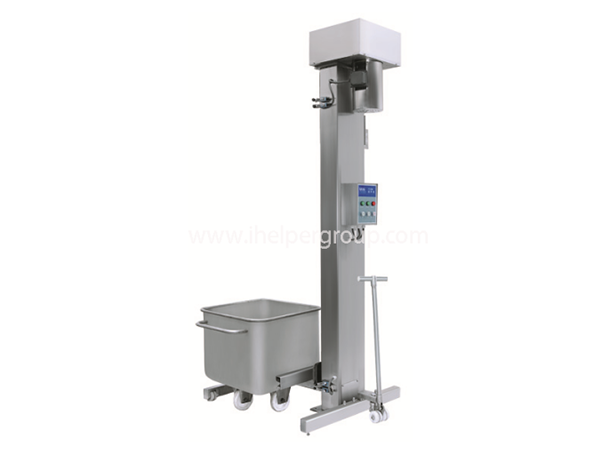
The working principle of a meat slicer machine on the coordination of mechanical transmission, automatic control and precision cutting technologies. Its core operation consists of three stages: feeding, cutting and discharging. Details are as follows:
I. Feeding Stage: Constant-speed Conveying and Positioning
1. Automatic feeding system
Conveyor belts, rollers or vacuum suction devices deliver meat to the cutting area. For fresh meat slicing, the conveyor belt runs at a steady speed to ensure consistent feeding and uneven slice thickness caused by speed fluctuations.
2. Flexible pressing mechanism
Some units are fitted with customized flexible conveying and pressing components, which apply even pressure on the meat to prevent deformation during cutting. For example, fully automatic fresh meat slicers with flexible pressing design avoid water extrusion and meat loosening, and preserve the original muscle fibers of the meat.
II. Cutting Stage: High-speed Rotation and Precision Control
1. Core cutting components
Rotary blade: A motor drives the circular blade to rotate at high speed. The sharp edge generates strong cutting force to slice meat efficiently.
Reciprocating blade: Driven by a crank-link mechanism, the blade moves back and forth in a straight line. It is ideal for tough meat or meat with tendons, which can cut through sinews thoroughly and keep slices intact.
2. Thickness adjustment device
The slice thickness is controlled by adjusting the gap between the blade and the feeding platform. Two common adjustment types are available:
Knob/dial type: Manually turn the knob or dial to change the gap. It is suitable for applications with moderate precision requirements.
Electronic control type: Sensors and control systems enable high-precision adjustment with an accuracy up to 0.1 mm, meeting the demands of high-end catering and food processing.
3. Intelligent control system
Parameter presetting: Operators can set cutting speed, slice thickness, quantity and other parameters via the touch screen or control panel. The machine operates automatically according to the preset settings.
Real-time monitoring: Sensors keep track of the cutting process. The system will stop automatically and trigger an alarm once abnormalities are detected to guarantee operational safety.
III. Discharging Stage: Automatic Collection and Continuous Operation
1. Discharging device
Sliced meat is transported automatically to collection containers via conveyors or chutes. Some models are equipped with sorting devices to categorize slices by thickness or shape.
2. Continuous operation capability
Fully automatic meat slicers support 24-hour non-stop operation. The automatic cycle of feeding, cutting and discharging greatly boosts productivity. Large meat processing plants use such equipment to handle hundreds of kilograms of meat per hour, with efficiency over ten times higher than manual slicing.
IV. Auxiliary Functions: Safety and Sanitation Design
1. Safety protection
Enclosed housing: The blade assembly and transmission parts are fully enclosed to prevent personnel from accessing hazardous areas.
Multiple protection devices: Equipped with infrared induction, emergency stop upon cover opening and overload protection to eliminate work injuries.
2. Sanitation design
Food-grade materials: The meat slicer machine is mainly made of 304 stainless steel, which features corrosion resistance and easy cleaning, complying with food processing hygiene standards.
Modular structure: Core parts including the blade assembly and feeding platform adopt quick-dismantling design for convenient daily cleaning and maintenance.